|
All up weight came in at 22 oz. Prior
to the first flight I measured the thrust to be 16 oz at full
throttle. The Density Altitude was around 800 feet with a temperature
of 71 degrees F and an altimeter setting of 29.97 in Hg. With
a static thrust to weight ratio of 0.72, the F-35 should have
great climb performance.
The brushless
motor and included battery were tested with a Hyperion E-meter
and the results are below:
|
E-Meter
Test Results
|
|
Approximately
50% throttle
|
100%
Throttle
|
|
Volts:
|
11.52
|
11.25
|
|
Amps:
|
11.3
|
31.2
|
|
Watts:
|
130
|
329
|
|
RPM:
|
25,200
|
37,200
|
Before flying
the F-35 at the field I wanted to know what kind of flight times
that I could expect from the 1300 mAh battery. At full throttle
the F-35 cut the engine off at just over 2 minutes and produced
16 oz of static thrust. At 1/2 throttle on the F-35 lasted much
longer at 7 minutes producing 8 oz of thrust.
The transmitter
has a high/low rates switch. For the first flight you will want
to have the control throws on "low". I would recommend
high rates after you have had a few flights of experience with
this airplane. The book gives no information on control throws
but the settings I used in this review were:
|
Control
Throws
|
| |
LOW
|
HIGH
|
|
|
Ailerons:
|
0.2"
|
0.9"
|
Up |
|
0.2"
|
0.4"
|
Down |
|
Elevator:
|
0.4"
|
0.9"
|
Up |
|
0.4"
|
0.6"
|
Down |
 |
|
No
Problem Grass Takeoff
|
|
 |
|
The
F-35 can climb!
|
|
The first
flight was a ROG (Rise Off Ground) takeoff from the grass strip.
The field was hard packed and the grass was short. This model
will take off from grass but would be much more comfortable flying
from pavement. To save the battery I put the F-35 in the middle
of the runway and checked the runway for the smoothest takeoff
line.
Advancing
the throttle the model accelerated quickly as can seen in the
video. The climb out was excellent with only marginal trim required
in roll. This thing is FAST! I quickly reduced to just below 1/2
throttle. The F-35 cruises comfortably at 1/2 throttle, but for
aerobatics you will need higher throttle settings.
The control
responses are excellent even at "Low" rates. The F-35
is not difficult to fly, but it is easy to over control and is
fast. Flying this plane with a transmitter strap and your thumb
and finger is recommended for more precise control. This planes
does go where you point it.
On high rates
the roll rate is very fast (something on the order of 720 degrees
per second (or 2 rolls per second). The airplane rolls straight
with no tendency drop the nose. As can be expected from an airplane
with a short wing span and no dihedral, there is no "self
righting tendency". This makes the airplane very fun to fly.
The pitch
is very responsive at speed. The model requires just a bit of
elevator in the turn especially at lower speeds. This can be tweaked
with fine tuning the C.G.
This model
doesn't have any rudder control (the nosewheel is controlled by
the rudder stick for steering on the ground) so don't expect IMAC
maneuvers from it. It will do all the basic maneuvers such as
rolls and loops. Try to avoid any managers that may get it to
spin since there are no rudders. I found that when the plane got
too slow if I dropped the nose it would recover.
When landing
I liked to cut the throttle completely and glide in. With the
trim set for 1/2 throttle cruise it would fly a nice power off
approach with little or no flare needed for landing.
 |
|
Approach
to Landing
|
|
 |
|
Realistic
in-flight looks
|
|
Although not
a park flyer, you can fly this plane at smaller fields. I would
recommend a bigger area than your local ball park because this
jet does eat up sky quickly. To fly this airplane in smaller fields
keep your throttle settings low and your speed down. If you fly
in low light or near dusk you may want to paint the bottom of
the airplane white. With the gray on gray paint scheme this model
can be difficult to see in low light conditions.
The nose gear
came loose after a few flights. A quick turn with the Allen key
will tighten it back up. Some red thread locker will keep the
screw from coming loose. Be careful not to over tighten the stop
screw because the coupling that holds the nose gear on is made
from aluminum and will strip easy.
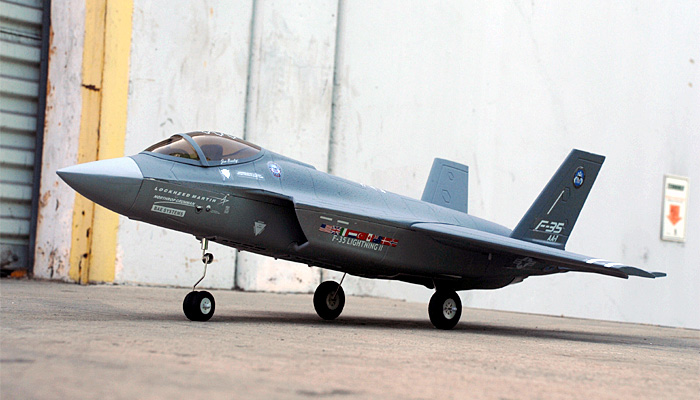
The
airplane has very realistic in-flight looks. At the field everyone
stopped working on their planes to watch this model tear the sky
up. The fan noise combined with the realistic looks makes flying
this airplane a unique experience.
|
 Loading Image...


